
The Billion Dollar Bathtub
From the Summer 2026 Issue
Behind the doors of Lake Pend Oreille's not-so-secret submarine base
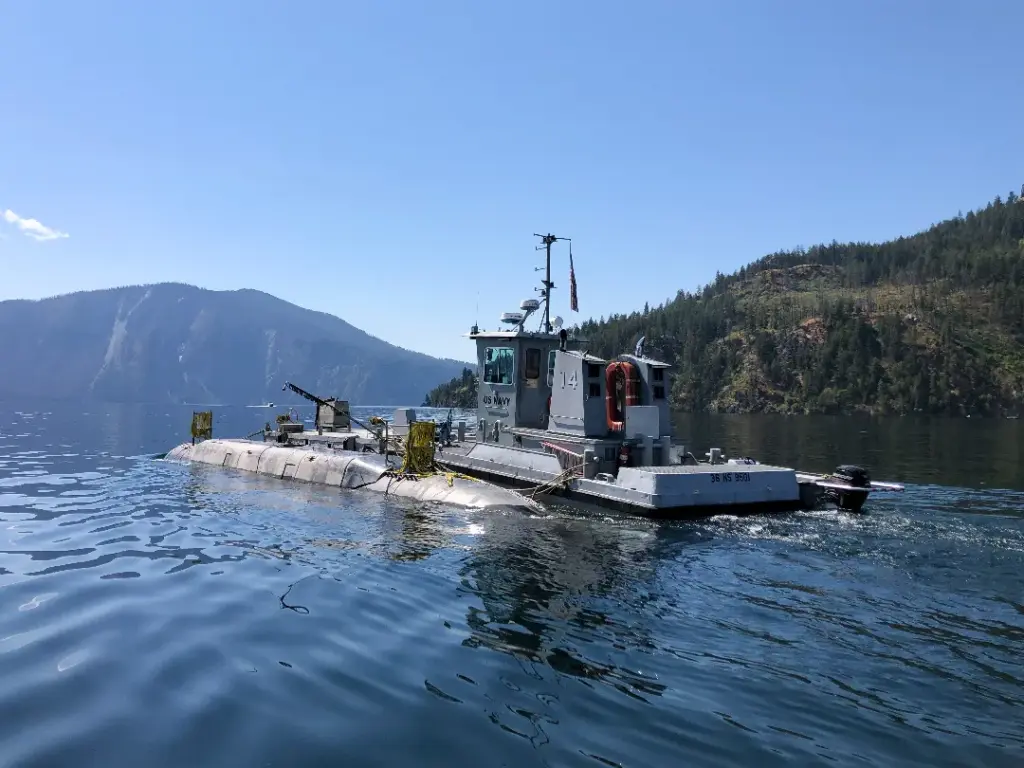
Should you happen to see a large submarine floating in the southern end of Lake Pend Oreille there’s no need to panic. You’re welcome to check it out – from a safe distance. Photo courtesy U.S. Navy ARD
Whether you’ve braved the Long Bridge Swim, boated its vast 111-mile shoreline, or simply paused at a scenic turnout to drink in the view, you likely feel a deep appreciation for Lake Pend Oreille. Most locals know the landmarks: the sandy stretch of City Beach, the nesting eagles and the fenced-off Navy base at Bayview. But while the lake’s surface is a playground for the public, its 1,000-foot depths hide a high-tech mission that remains largely a mystery.
What’s not as widely known is that the U.S. Navy’s Acoustic Research Detachment base in Bayview, which straddles the Bonner-Kootenai County line and is surrounded by fencing, a security gate and no trespassing signs, is probably one of the top ten employers in Bonner County. “We’re staffed at about 135 people right now,” said Seth Lambrecht, a mechanical and ocean engineer who has worked at the site for two decades.
“About half are engineers and scientists. The rest are welders, fabricators, electricians, maintenance staff—basically every trade you need to build and operate everything in house.”
The base exists partially because of the huge naval training base at Farragut—which was effectively the largest city in Idaho in the 1940s—and the lake’s incredibly unique geology. The detachment operates as a part of Naval Surface Warfare Center, Carderock Division, one of ten such divisions under the Navy’s Naval Sea Systems Command enterprise. It occupies 25 acres in Bayview, with a couple shore-based locations on the lake’s western shore. ARD staff conduct research that directly influences the stealth performance of American submarines, with a rich history of success.
A Lake Like No Other
After World War II, the Navy retained a small portion of land from the former Farragut Naval Training Station, now Farragut State Park. For a decade, only a handful of personnel kept the site minimally staffed.
Then came the Cold War.
As submarine stealth became a strategic priority, researchers needed a controlled environment—essentially, as Lambrecht puts it, “a giant bathtub”—to measure sound without the unpredictable variables of the open ocean.
Lake Pend Oreille and its depths of up to 1,150 feet proved almost geologically perfect. Below roughly 100 to 150 feet, the water remains a constant 39.6 degrees year-round, creating an isothermal environment where the speed of sound doesn’t fluctuate. The south end of the lake has virtually no underwater current, and thanks to glacial formation, much of the lake bottom is remarkably flat, covered in sediment rather than jagged rock.
“All those things combined,” Lambrecht explained, “make it probably the most unique, geologically formed lake in the entire world for acoustic testing.” For engineers attempting to measure faint sound signatures from submarine components, eliminating variables means everything. In the ocean, shifting temperatures, currents and salinity distort results. On Lake Pend Oreille, sound behaves predictably.
Submarines – Without Sailors
The Bayview facility doesn’t operate full-scale submarines, or offer rides to curious locals, even if they wanted to—every vehicle is unmanned.
The largest, the Large-Scale Vehicle-2 (LSV-2), is a 111-foot, 205-ton autonomous model powered by a 3,000-horsepower electric motor. Others range from roughly quarter-scale to one-third-scale models of modern submarine classes. These vehicles can carry full-scale hardware for testing—an ability unmatched elsewhere in the world.
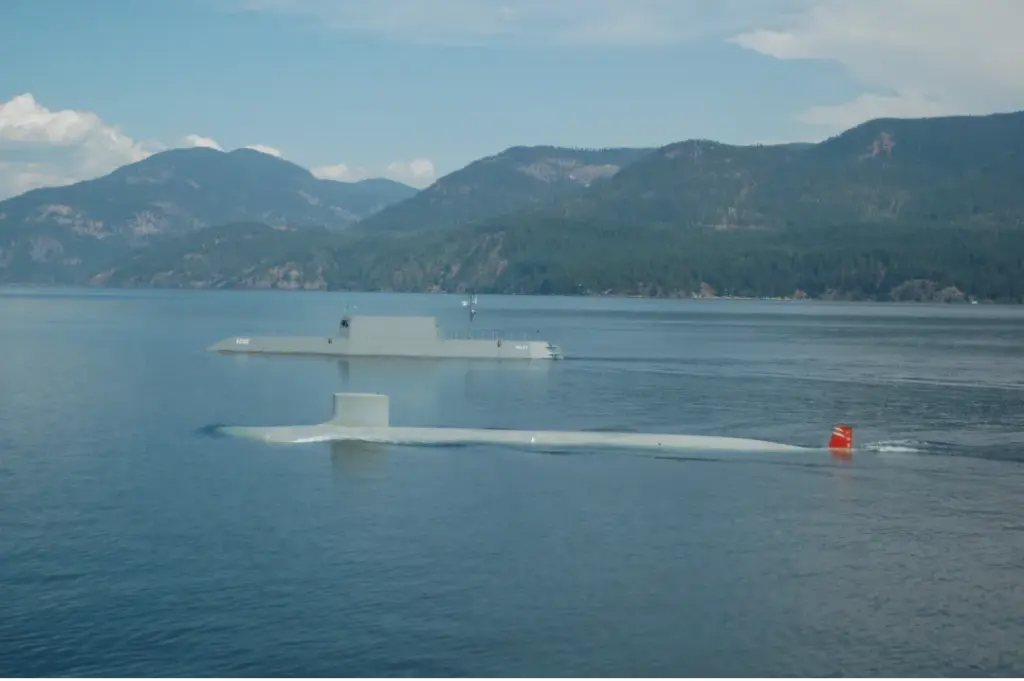
The Large-Scale Vehicle 2 (foreground) is a model of a Virginia Class submarine. The LSV SeaJet is in the background. Photo courtesy U.S. Navy ARD.
Everything the detachment operates is unmanned by design. “If you put a person into a submarine for R&D testing, you’re putting someone’s life at risk,” Lambrecht said. “With unmanned platforms, if something happens, it’s a dollar figure—not a life.”
Operations often take place at night or during off-peak boating hours. The lake remains fully public. Before tests, staff clear the ranges to avoid conflicts with fishing boats or pleasure craft. Most interactions with the public are minimal—and friendly.
An Underwater Stadium
Perhaps the most interesting ARD feature lies invisible to boaters overhead: the Intermediate Scale Measurement System, a massive circular array roughly 1,000 feet in diameter anchored to the lake bed. Imagine an inverted football stadium on the bottom of the lake, equipped with thousands of acoustic sensors.
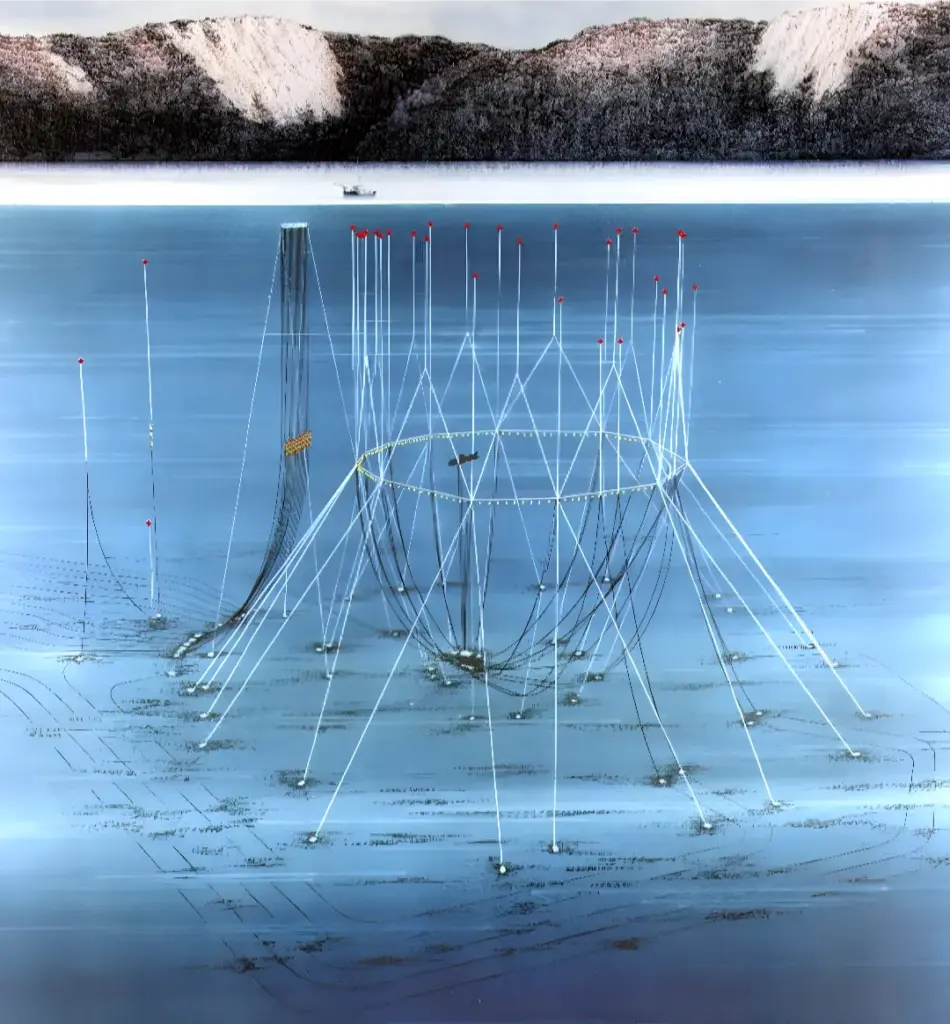
The array at the heart of the base is roughly 1,000 feet deep and wide in diameter, and is connected to the base by roughly 14 miles of cable on the bottom of the lake. Graphic courtesy U.S. Navy ARD.
More than 14 miles of underwater cable connect this array back to the Bayview base, allowing researchers to transmit and receive acoustic signals from shore. Hundreds of millions of dollars in infrastructure rest quietly below the surface.
From these arrays, scientists study two fundamental aspects of submarine performance: making vessels quieter (defensive stealth) and improving sonar systems to detect adversaries (offensive capability). Research ranges from propulsor design and cavitation control to vibration isolation and structural acoustics.
In recognition of the importance of the acoustic center to the Navy, and featuring technology developed there, the USS Idaho was commissioned into the Navy fleet in early spring.
Nestled up to the Houseboat community
Despite its global significance, the Bayview detachment feels deeply local. There’s no base housing; employees live in Sandpoint, Coeur d’Alene, Spokane Valley and even as far as Bonners Ferry. Many are lifers.
“Once you come here, you pretty much finish your career here,” Lambrecht said. “It’s a tight-knit community.” The North Idaho lifestyle, with its plentiful outdoor activities, is a powerful draw.
In a region shaped by timber, tourism and the legacy of Farragut’s World War II training base, the modern Navy presence is more subtle but still considerable.
On a calm summer evening, as anglers and cruising families drift atop a thousand feet of water, few spare little thought that the same lake supporting recreation and legend—yes, even the mythical “Pend Oreille Paddler”—is also advancing the next generation of submarine technology.



Leave a comment