
When Winter Really Meant Winter
From the Winter 2027 Issue
Remembering some big snow years
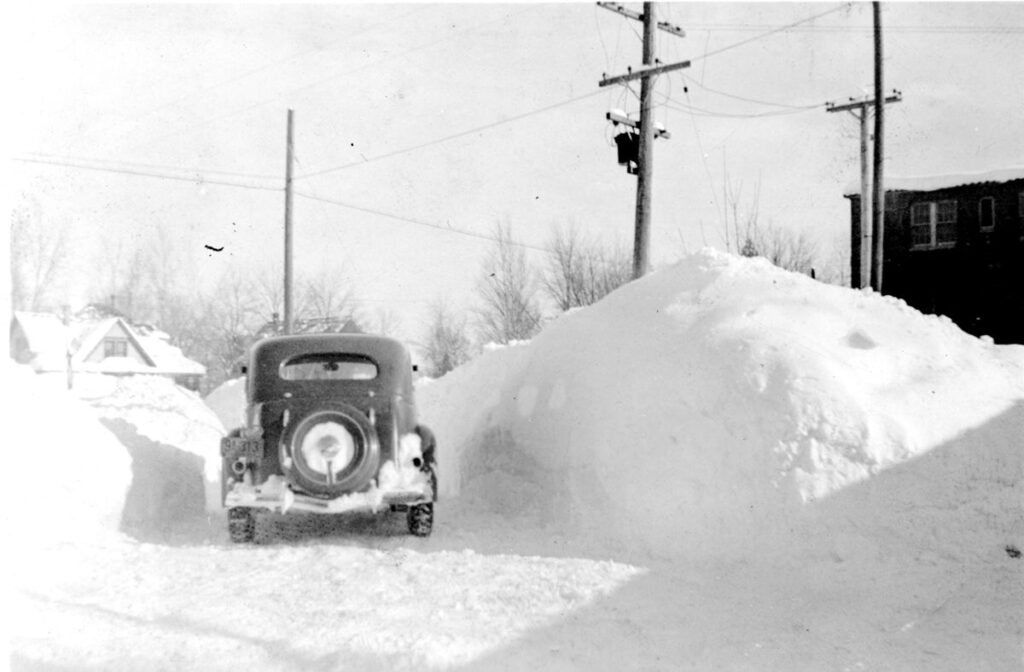
A Ford car parked in the snow behind the Moon Mortuary in 1935-36. Photo courtesy Bonner County Historical Society & Museum, donor unknown.
There’s an old Sandpoint adage that you’re not really a local until you’ve made it through two winters. And there’s another about identifying a longtime Sandpoint resident: Ask about winter and, before long, you’ll hear about how the snow used to be “up to here,” accompanied by a hand gesture somewhere around shoulder height.
It’s easy to dismiss the snow stories as the natural exaggeration accompanying the passage of time. Every generation apparently walked six miles to school barefoot through four feet of snow, uphill both ways. Except, in Sandpoint, some of those stories really are true.
Consider the winter of 1968-69
Duane “Blacky” Black was a high school sophomore that winter, and he remembers it less as a series of snowstorms than as one long, cold siege. “We only went to school three days in the whole month of January,” he recalled. “And I remember them letting us out at 10 o’clock. So we never did do a full day.”
For a teenager who liked to ski, of course, there were worse problems to have. The only roads that the city could keep relatively clear of snow were the highway and the road to Schweitzer, so snowmobiles were allowed on the streets. Black and his friends would walk down to Main and Boyer, stick out their thumbs and hope somebody was headed toward the mountain.
“But it was so cold out that we could make like one run to Midway and we’d have to come in and sit on the heaters for a couple hours before we could go back out.” The temperature eventually dropped to 37 degrees below zero (an unofficial Idaho
Panhandle record).
And then there was the snow. Between December and the end of January, Black remembers about 82 inches falling. “So the drifts were right up to the eaves of the houses,” he said. “I don’t remember shoveling off any roofs, but I’m sure I did.” What made that winter particularly memorable was the combination of snow and sustained cold. “That one was so bad because of temperature. The warmest it got was single digits. And most of the time it was in the teens to 30 below zero with a wind.”
Steve Klatt remembers that winter, too. He grew up in Garfield Bay, where being snowed in wasn’t a figure of speech. He also recalls the road into his neighborhood being completely closed. When crews finally brought in a crawler tractor, they had to clear the snow away from his car before he could even see it.
The car was a 1949 Plymouth. “It was a big old lumpy car that’s about as big as a Suburban today, and they couldn’t even see that there was a car there,” he said.
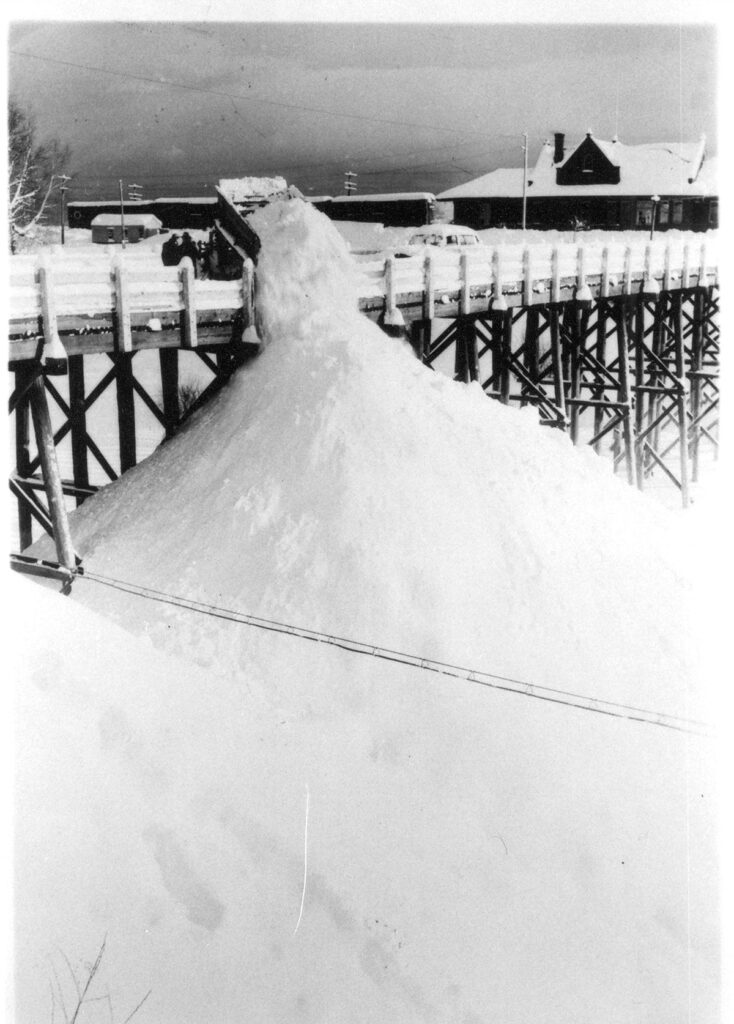
A dump truck dumps snow off the Cedar Street bridge during the winter of 1949. A Jim Wolfe photo, courtesy Bonner County Historical Society & Museum.
The Roof-Wrecker
Roughly 28 years after the big winter of ’68-69 came another one that gave an entirely different generation of Sandpoint residents its own snow story. The winter of 1996-97 didn’t necessarily match 1968-69 for sustained cold, but it delivered something Sandpoint residents remember just as vividly: snow, and lots of it.
By late December, newspapers were reporting that parts of the region had accumulated 18 feet of snow since November. Roofs were beginning to collapse and young entrepreneurs were making good money shoveling. Washington Elementary had an 11-foot snowdrift on its roof. On December 30, the auditorium roof at Sandpoint High School collapsed, leaving a 60-by-30-foot hole. Snow loads in some places were approaching 80 to 100 pounds per square foot, with more than four feet of snow on some roofs.
By March, the University of Idaho research station on North Boyer Avenue had recorded 140.2 inches of snow since November. That year 173 inches of snow fell in Sandpoint, breaking a 23-year-old record of 171 inches set in 1974. The snow had been on the ground in town for essentially four straight months. If you lived here then, you remember it. I certainly do. It was my third year working at Schweitzer, in the Skier Services department, and the single-story house I rented on Ella Street gradually disappeared beneath the snow. There was a seemingly endless cycle of shoveling, moving snow, trying to figure out where to put the next load and then discovering that another deep storm was already on its way.
My Skier Services boss, Dave Morris, recalled, “I remember when we were waiting for the hill to open and had minimal snowpack. Then, we got 70 inches in seven days, so that worked out pretty well. We had a few days of 16 inches of snow [new each day].”
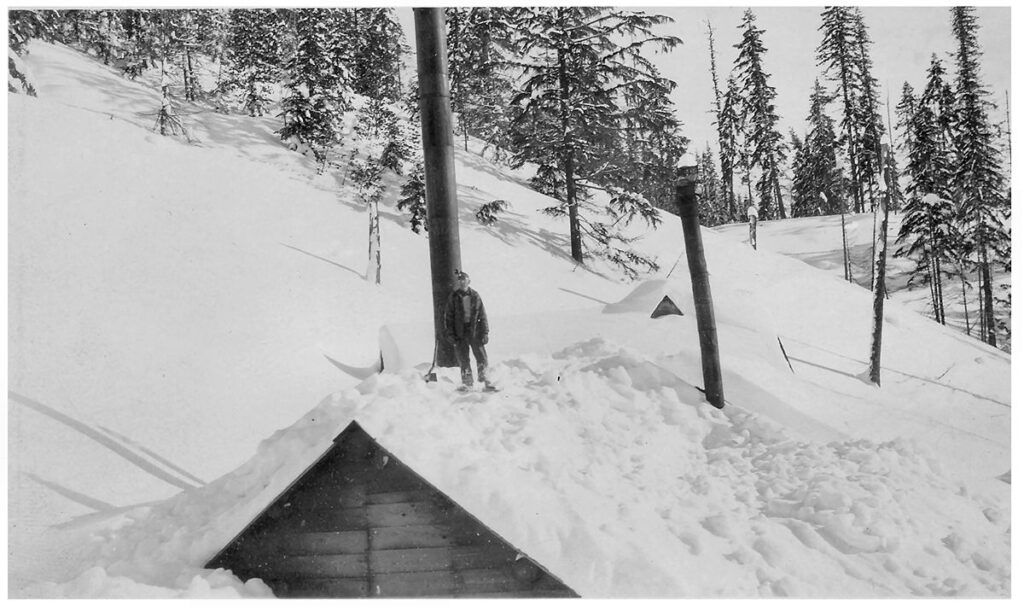
Burnt Cabin Railroad, an Ohio Match Company logging railroad, was located north and east of Hayden Lake in the Coeur d’Alene National Forest. It was constructed in 1923 and operated until 1942. All operations ceased before snow came in fall. Only a caretaker remained in camp, who in this scene has been shoveling snow off a roof. The large stove pipe suggests it may be the cookhouse. Photo courtesy Bonner County Historical Society & Museum from the Alan Robertson Collection.
Failing Memories or Fading Winters?
Are Sandpoint winters actually different now, or are we simply remembering the memorable ones? Are the days of Winter Carnival snow sculpture contests over? Is the K9 Keg Pull downtown always going to involve trucked-in snow?
According to Charlotte Dewey, a warning coordination meteorologist with the National Weather Service office in Spokane, the answer is clear: Yes, the winters really are changing.
Dewey has worked throughout the West during a career spanning nearly two decades, including more than six years in the Spokane/North Idaho region. When she looks at long-term climate records from stations such as the Priest River experimental station, she sees something that backs up the memories.
“The average temperatures do show an increase from year to year, going all the way back to like 1954,” Dewey said. “And it’s a slow increase, but what that alludes to is that winters are becoming warmer.”
Snowfall, meanwhile, is moving in the opposite direction. “It’s a slow decline,” she said. “From around 1915 all the way through 2024-25, the total snowfall has decreased almost 20 inches.”
The numbers become even more striking when you look at sustained cold. “We’ll still probably have days that are cold or below zero,” Dewey said. “But the number of days that we’ve had that are below zero or below negative ten, for example, it definitely has a sharp downward trend.”
There is another change that may be even easier to recognize. The winter season itself appears to be shrinking. “If we just go by temperature days, like the less than 32-degree temperatures for defining the winter… those days are decreasing,” Dewey said. And more winter precipitation is arriving as rain rather than snow.
That probably explains something many of us have noticed without necessarily putting numbers to it. Winters here haven’t disappeared. They just seem to have been evolving with warmer personalities. We get plenty of gray. We get rain. We get stretches of cold. We get snow. We get more inversion days up on Schweitzer. But those long, relentless combinations of deep snow and brutal cold seem to be increasingly unusual.
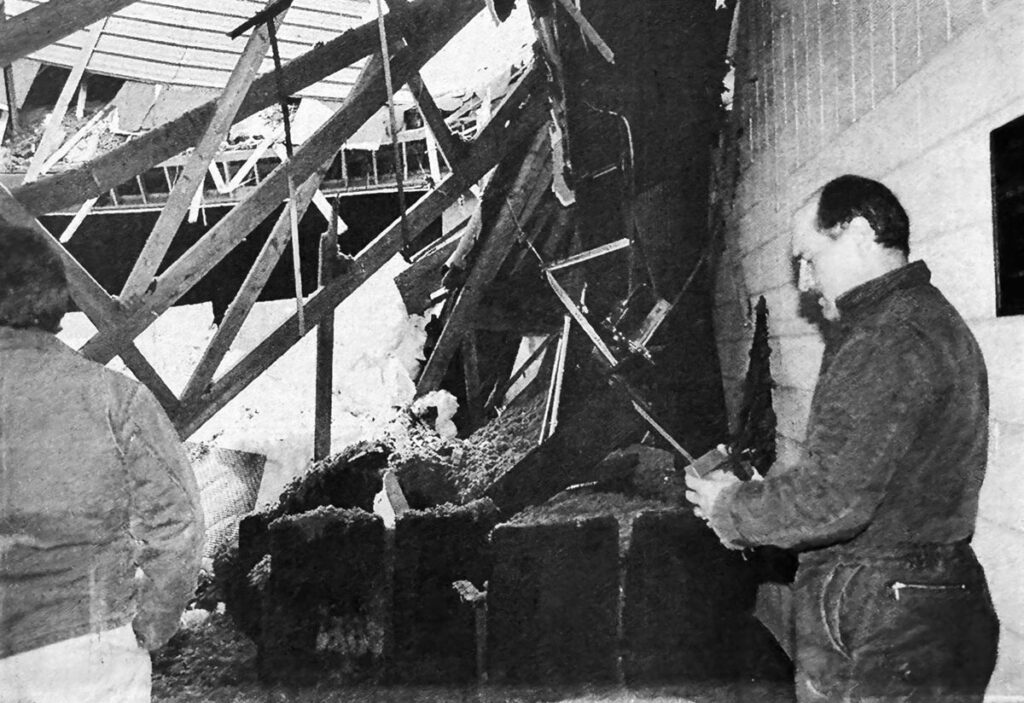
Bonner County School Board vice chairman Bill Osmunson examined what remained of Sandpoint High School’s auditorium after the roof collapsed December 30, 1996. Bonner County Daily Bee photo.
Warmer Doesn’t Mean Snow Free
Warmer air can hold more moisture, which means a warming climate doesn’t eliminate the possibility of a monster snowstorm. “So we still can get the bigger snowstorms because it does have that higher moisture content,” Dewey said. “It’s just that we have to get the colder air to come in and give us those potent storm systems that can give us the snow. Even if our snowstorms are infrequent, we could still get a big one that could produce a lot of snow.”
That helps explain how one winter can produce 350 inches at Schweitzer while another produces 90. Seasonal patterns such as El Niño and La Niña influence the overall character of a winter, while individual storms depend on the combination of moisture, temperature and atmospheric conditions that arrive at our doorstep.
“So it’s largely driven by El Niño or La Niña patterns on the whole for the seasonal totals,” Dewey explained. “But then each weather system that moves through, we get a cold front or a snowstorm that comes through on these shorter timescales. And if the air mass is cold enough, that cold air with the moisture will produce the snow.”
What doesn’t kill you
“So that difference helps explain what has changed—and what hasn’t. Because if you talk to people who lived through those winters, they don’t necessarily remember them as miserable. They remember them as events.”
Black remembers being a teenager who couldn’t go to school, couldn’t drive anywhere, and having to sit next to a heater after a single ski run. Klatt, who served as Bonner County’s road and bridge director, remembers roads disappearing and crews working essentially around the clock. And both remember something else: People simply accepted that winter could shut things down.
Klatt said that these days, the county has dramatically better equipment and capabilities. But there are very different expectations. “One of the biggest differences would be that, first of all, we have a lot more people in the county, but we were all accustomed in those days when conditions were bad, we just knew we weren’t going to get the level of service. People now expect a level of service that’s unrealistic in huge storm events.”
The reality is that you can’t plow everything at once. “You cannot keep up 24 hours a day plowing any road, so you really start working on, okay, do we have the thoroughfares open, the arterials open? You work in the highest priorities,” he said.
Trends Too Strong to Ignore
The Sandpoint of 1968-69 and the Sandpoint of 1996-97 really did experience winters that seem extraordinary by today’s standards. The measurements back up the memories.
But what’s in store for 2026-27? “Seasonal forecasts still do have a margin of error because they’re trying to predict out an entire season months in advance. And our models just don’t have the accuracy to go out that far,” Dewey said.
The most reliable forecast window is much shorter. “That’s really our best accurate window,” she said, referring to roughly one to three days before an event. “And that’s just because the computer models vary so much, because there’s so many variabilities that go into that. Weather systems will slow down, speed up, shift north, shift south and the whole forecast changes.”
And that variability is part of what makes North Idaho weather so interesting. Climate cycles are normal, Dewey said. There are periods of warmer and colder weather, more snow and less snow. The important thing is what the long-term record actually shows.
“What the data shows is increasing temperatures and decreasing snowfall,” she said. “So it’s generally been weaker winters and less intense, or however you want to describe it. But I mean, climate does go in cycles. So, there are periods of years of more snow and years of less snow.”
None of that means we’re finished with wicked winter weather. Far from it. All it takes is the right storm, moisture and enough cold air at the right time.
“Given the trend that we’re on right now,” Dewey said, the next five or ten years could point toward “less snowy and generally warmer and milder and probably more rainy winters.”
And while lots of people seem to be perfectly content with lots of snow at the ski hill and not so much down below, I, for one, miss the excitement that comes from huge snowbanks lining the streets, the stoke of impending powder runs and the ability to cross-country ski down Main Street or regularly fat-tire bike on snow at Pine Street.
That’s not a very scientific conclusion. But science doesn’t always mix very well when reminiscing about the days of wicked winter weather.