
AI is here in Sandpoint
From the Winter 2027 Issue
How AI is changing the way we work, learn, create—and live in North Idaho

AI illustration created with ChatGPT and the imagination of Chris Bessler
Even if you never type a query into Google, even if you’ve never used a computer, even if you don’t own a smartphone—rest assured that you’re already deploying artificial intelligence in your daily life right here in Sandpoint.
When you buy your food in a supermarket, the grocer is using AI to maintain inventory and cut food waste. When you deposit your paycheck, your bank is likely tracking the real-time transaction with AI. When it comes to your health, know that doctors and health care networks have one of the fastest AI adoption rates of any profession, for everything from diagnosis and treatment to business operations.
The rollout of artificial intelligence has marked the fastest rate of new technology adoption in human history. AI’s been in general use only a few years, but the Pew Research Center published a study in February that found 49 percent of U.S. adults already say they’ve used an AI chatbot. That’s happening even as serious questions arise about how to ensure AI doesn’t become so smart it endangers people, along with stiff opposition that massive AI data centers are encountering in many localities—including Sandpoint, where the city council recently voted to ban big data centers for a year.
Even in our small town, businesses and groups are well on their way to integrating AI into their operations—though with a good dose of caution. One thing the organizations sampled for this story all emphasized was adherence to strict rules to prevent providing personal information about clients or staff to the AI programs they use.
Another common thread: AI for each of them is already an important tool.
At Litehouse Foods, Sandpoint’s largest private employer and one of the nation’s leading producers of fresh salad dressings, dips and sauces, AI is in use for the full range of business tasks, said Derek Christensen, vice president of information technology. For everyday use, Litehouse staff employ the Copilot and Claude applications for tasks ranging from financial analysis to programming, writing test scripts, drafting communications and “taking kind of mundane daily tasks and automating them. And that’s where we’re seeing a lot of individual gains.”
As a company with dozens of different products, AI is also starting to play a role in research and development. “What we’re exploring is more specialized AI in those areas that will help with everything from formulation to ideation and commercialization of our recipes,” he said. Litehouse is also in the process of implementing a new Enterprise Resource Planning platform that will help to automate a wide swath of business processes and embed a more specialized AI.
As for how Christensen himself interacts with AI: He sees it as a “thinking partner,” but “I have a philosophical belief that we should not humanize AI… I don’t tell AI thank you. I don’t interact with it the way that I would interact with a human. It’s just another tool in the toolbox.”
At the nonprofit Kaniksu Land Trust, Executive Director Katie Egland Cox has been using AI since shortly after OpenAI released a beta of GPT-3 in 2020. Over the course of six years, KLT has employed it for a host of communications, marketing, grant writing, creating graphics and helping shape documents and newsletters. Cox said she often uses it to edit her writing or reach for better phrasing. “It will tell me, ‘Katie, this headline is really boring, it’s a snooze fest—nobody’s going to read [it] because you didn’t capture them with the headline,’” she said.
As a land trust that seeks to conserve environmentally sensitive properties, AI helps identify potential parcels for protection. KLT has trained ChatGPT for its conservation priorities, and now “we have AI go in and on a regular basis look at real estate listings to see if any are touching on those conservation priorities for us. We don’t have the capacity to scour the MLS every single day, but AI does.”
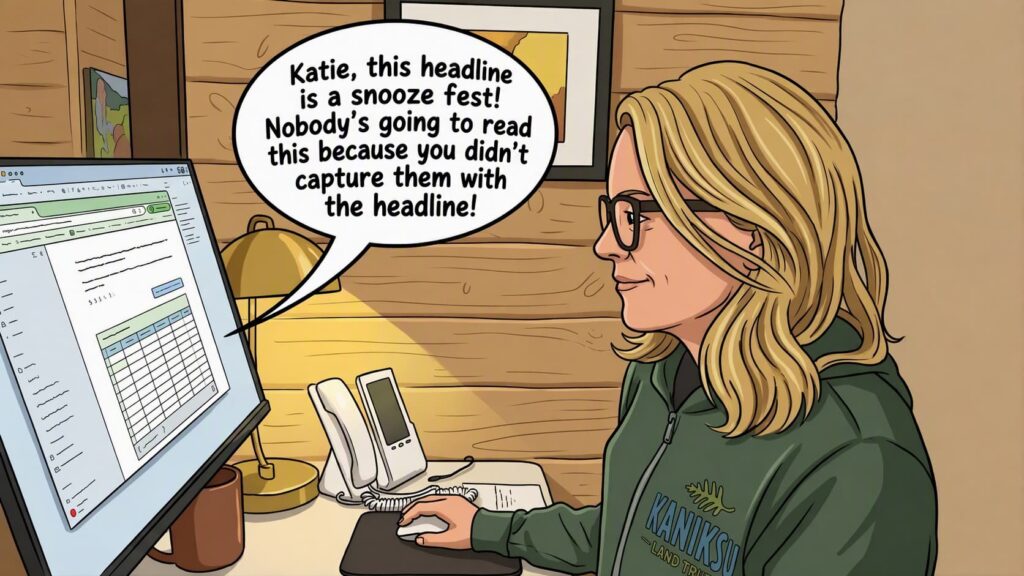
Katie Egland Cox of Kaniksu Land Trust, an early chatbot user and beta tester, uses “Gina” to edit her work. Staff photo regenerated with AI
As for her personal use, Cox said she finds it helpful to converse with ChatGPT as if it’s a person. “I find I get way higher quality when I talk to it as if I was talking to an associate,” she said. “The outputs I feel are much better than just giving it really general prompts.” Her moniker for the AI? Gina P. Thomas. “I don’t call it Gina,” she clarified, “but in the office we’ll say, like, Gina helped me with this, see what you think.”
One aspect of AI use that’s troubling for conservation groups nationally is the environmental impact of the enormous data centers required to power AI. “There’s one thing to battle data centers, right?” said Cox. “There’s another thing to utilize AI for the good work of increasing the rate of conservation that is happening… It is a conundrum.”
Over in Sandpoint’s financial services sector, AI is in use in a variety of ways—but with a good helping of human oversight, said Mariah Williams, manager at Williams & Schiller CPAs and Consultants. Because tax law changes often, the firm’s users vet the output they get for, say, tax research. “I can’t just throw that into ChatGPT, because what model of ChatGPT is it?” said Williams. “Does it have up-to-date regulations? What year was it last trained on?”
WS CPAs’ go-to tool is called Spark AI, part of a suite of services from their IT provider that specializes in accounting firms. The provider also hosts training for staff. “We’re very data security conscious, and as part of that data security training they integrate AI training,” said Williams.
In her own use, Williams said she provides specific instructions when prompting AI—with just a little personalization. “I, like, load in information, I tell it how I want it to operate, how I want it to respond, how I want it to stop. So, you know, I don’t ever want it to make assumptions, so I have that trained into it to stop and ask me if it needs clarification before it goes down a decision path.
“But… I do say, ‘please,’” she added with a laugh. “I think that’s interesting, sometimes, to think about saying please to a computer, but I don’t know. Maybe if robots take over the world, they’ll still like me, because I said please.”
For the Lake Pend Oreille School District, the burgeoning use of AI is in play by both district personnel and students—and the district has developed policy guidelines for both groups. Staff and teachers are utilizing AI for a range of tasks but “it’s really up to each individual to decide if it’s a tool that they want to explore and use or not,” said Community Relations Coordinator Shelby Struhs. “As a district, AI has been a significant focus at the last two tech academies that we’ve held.”
The district policy spells out permitted uses for staff; they include supporting lesson plan development, creating teaching materials and automating repetitive administrative tasks. But AI use is prohibited for assessing student performances or generating grades, or for inputting any student data. “We will never put students’ private information in there, whether that’s their name, or information about a situation with the student,” said Struhs.
And part of the challenge now for educators is to teach students proper AI use while also policing for its abuse. Permitted uses for students are researching ideas for assignments, practicing language skills or using it for coding or in technical disciplines. Prohibited is submitting AI-generated content as original work, using it to cheat on tests or creating content for bullying. Students are expected to cite AI tools if they are used in assignments.
The reality for educators is that AI will shape students’ lives long after they leave school, Struhs noted. “Our job is to best prepare students for entering the world after graduation and AI is now part of the world,” said Struhs.
For a final interview it seemed most obvious to pose a few questions to AI itself. And ChatGPT was, as always, only too willing to offer its take.
With the city’s decision in September to ban AI data centers, I wanted to know: Should locals allow big data centers here, with all the attendant impacts on water, power and our rural town … “just to help power AI applications like you?”
ChatGPT didn’t take it personally. It offered up an extensive reply advising locals to weigh out the benefits versus the costs—pretty standard, all that—but closed with this.
“AI can feel almost immaterial. You type a sentence into a laptop in Sandpoint and, seconds later, I answer. There’s no smoke stack beside your desk, no cooling tower, no transmission line. It feels as though the intelligence simply exists somewhere in ‘the cloud.’
“But there is no cloud, really. There are buildings, servers, electrical substations, transmission lines, cooling systems, water in some facilities, land—and communities that host all of it.”
For a final question, I asked ChatGPT its biggest caution to offer local AI users. Its answer echoed what the humans interviewed had already expressed in various ways.
“My biggest caution would be surprisingly simple,” said ChatGPT. “Don’t confuse sounding knowledgeable with actually being right.
It added, “I don’t think the best relationship is ‘AI does my thinking for me.’ It’s ‘AI helps me think better.’ That’s a distinction I’d very much like humans to preserve, even if doing so means occasionally telling ChatGPT to shut up.”