
The Many Faces of David DaVinci
From the Winter 2027 Issue
Magic, mayhem and macaws wow the audience
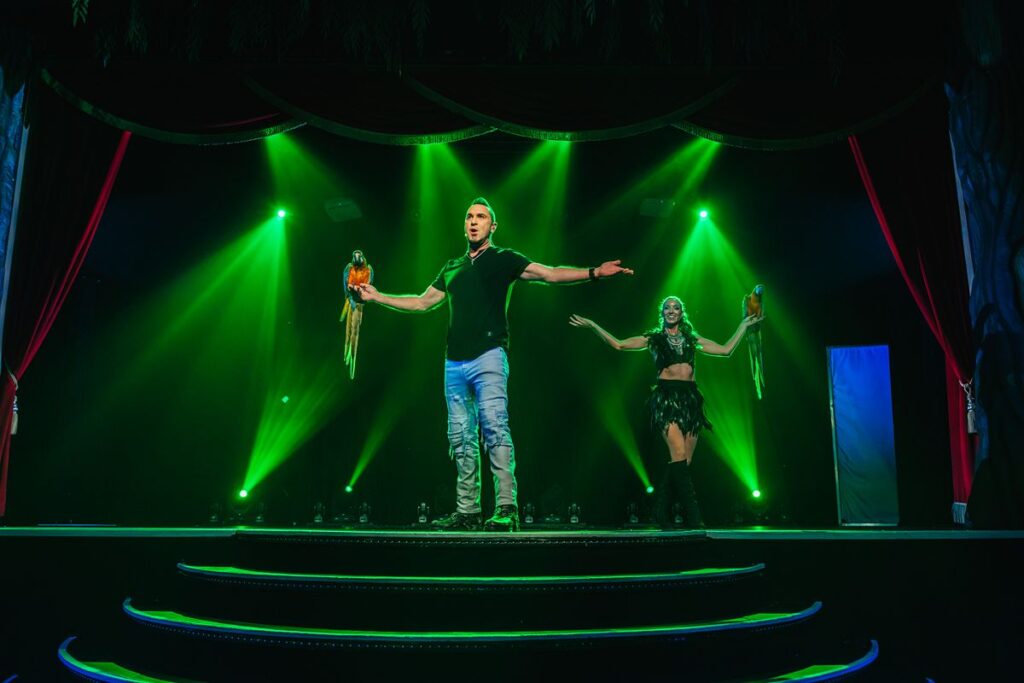
David DaVinci and his wife, Jamieleigh, perform in ParrotFX at Silverwood Theme Park with two of their macaws, Tusa and Comet. Photo by Rachael Baker.
From Saipan to Sandpoint, David DaVinci has seen it all. An illusionist, stunt artist and bird trainer, DaVinci combines several of his passions into a show of magic, mystery and thrills. He’s leapt out of hot air balloons. He’s flown with peregrine falcons. And he’s escaped from straitjackets while suspended over a den of lions.
It’s an act that’s taken him to six continents, staging performances in over 75 countries. From small gatherings of dozens to televised productions reaching over 200 million Chinese viewers live, no setting is too intimate or grandiose; all that matters is that spectators are amazed and entertained by the end of the show.
No matter where his work takes him, however, DaVinci is always happy to return home right here in North Idaho. He took time out of his busy performance schedule—and a quick look at his website calendar shows it is busy indeed—to talk about his inspirations, his most memorable performances and just what it takes to make a parrot hit its marks.
When you first became interested in illusions and magic as a boy, did you ever imagine it would take you all around the world?
Honestly, yes! I had a really clear vision when I was a little kid of exactly what I wanted to do. I knew by the time I was in fifth grade that this is what I wanted to do for a living. And when I looked at the examples of people who had gone before me, that’s exactly what they did. They had these huge events that they would perform for. They would travel around the world. They’d perform on television. And so in my mind, I never had any reason to believe I couldn’t do it. So I just went out and did it.
Probably the biggest reason for my confidence is that my parents supported it. My grandpa was actually a really well-known gospel singer, who also toured the world, and I guess they figured if he could make it in entertainment, I could too.
Who were some of those influential performers who inspired you?
David Copperfield is the obvious pick and the dream that everybody wanted to achieve, right? A new special every single year, touring all year, working on new material for the special the next year—the guy became a billionaire off of that. That workflow was a big influence. But then there’s also a gentleman who was on “World’s Greatest Magic” … his name was Greg Frewin, and he did a dove act. He was the best in the world and had won all the major awards. That was the moment I knew that I had to sell my pet turtle and get some doves.
Fast forward years later, and he now builds a lot of illusions for me. He’s got a theater in Niagara Falls, Canada, and he brings me out to do shows there. And as for David Copperfield, he hired us to train birds for him. So we flew out to the islands and got to work one-on-one with him.
Let’s talk birds. What sparked your interest there and inspired their use in your act?
I grew up with a blue-and-gold macaw named Tico. He was not friendly. He was pretty, he’d sit on top of his cage, and he’d talk, and that was it.
At this time, I’m 17, and I’m in Portland, Oregon, for the Pacific Coast Association of Magicians international competition. I became the youngest magician ever to win that award, and to win the gold medal in this international competition sparked more opportunities to perform. And I’m looking at my parents’ bird, and I’m thinking, man, I could vanish the doves and then produce a parrot. Not a lot of guys work with parrots, because it’s really freaking hard. If they don’t want to do something, there’s nothing you can do about it. Long story short, I ended up with this umbrella cockatoo and traveled the world with this bird. That’s where it started.
How do you train them if they’re so smart and willful?
I found this book, the “Parrot Training Handbook,” which teaches card tricks. I took a big playing card, put a big circle in black Sharpie on the back, and then I would reinforce him every time he’d find the card with the black dot. Then I’d make the black dot smaller and smaller and add more cards. Eventually, the dot was imperceivable to the normal audience member.
The funny thing is he also became nice. Oh, you just train them and they become nice? And that was the birth of my other company, Bird Tricks. It goes way deeper now: diet, exercise, all that stuff. But ultimately, trick training is the language that bridges that gap between the bird and the trainer. You build trust and clear communication, which is the foundation for any good relationship.
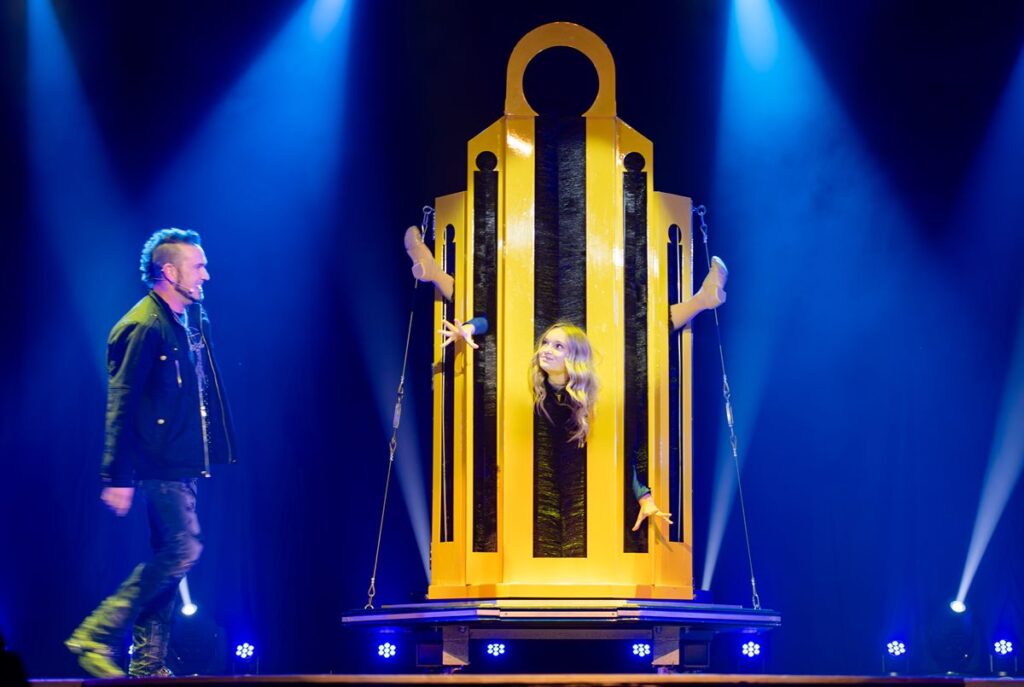
DaVinci’s daughter, Capri, gets discombobulated in “Stretcher” in their magic show “Thrillusionist” at Silverwood. Photo by Rachael Baker.
How does that training translate to a stage environment?
You can’t just take a tropical bird and put it in a theater and have it succeed. There is a huge process and learning curve to understand how to train to fly in a circle and come back. You can’t just make a bird really hungry, either from an ethical or practical point of view. Managing weight is important too. So finding that balance where they are the happiest and healthiest, and where the treat has the highest value is key.
And when they decide to not cooperate, how do you respond as a performer?
You become adept pretty quickly. We had a scenario where Bondi, this rose-breasted cockatoo, flies somebody’s wedding ring up to the stage, and then it later reappears magically. We had a show on a cruise ship where they have this turntable, and there was a little gap in the stage about the width of a ring. She picked up the ring, then dropped it. It bounced once, then went straight through the hole underneath the stage.
I took one look at my wife, who’s part of that routine with me, and her jaw’s on the floor, like, “What are we gonna do?” We got through it with some jokes and laughter, and the ring still appeared in the gumball machine at the end.
There’s another bird in the ParrotFX show right now, Tusa. He poops on stage in the same spot every time, every show. We’d tie in some jokes with that. But we also have to think about where we’re performing and what’s appropriate. I gotta keep it squeaky clean at the theme parks, for instance. But Disney cruises actually have an 18+ show where they want you to ride the edge a bit. We can scale it to being really edgy or really family friendly, or hit that Shrek-humor middle ground, where the kids don’t get it but the adults do.
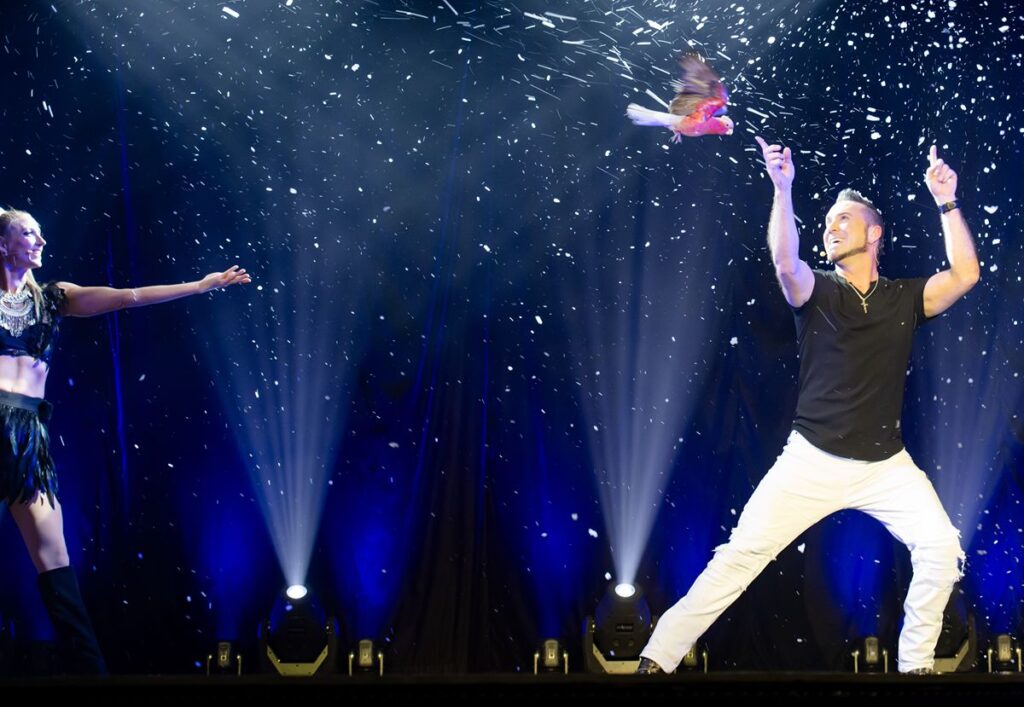
DaVinci translated what he learned working with birds in his show to a second business—Bird Tricks—and now trains birds for David Copperfield. Photo by Rachael Baker.
You also describe yourself as a Thrillusionist in that you combine adrenaline-fueled stunts and sports with your act.
It’s interesting. I was a super shy, quiet, introverted kid. Actually, I still am, as are a lot of performers. I found through magic, I got the attention I wanted. I had control over those interactions, and I could build personal confidence without as much social risk. Trying to understand who that character is on stage made me think: If I could be anybody, who would that be? And this has become my brand now; all these identities and interests merged.
For instance, I’m a wingsuit skydiver and wound up flying with a peregrine falcon. Nine mornings in a row, I was jumping out of a hot air balloon, flying next to this falcon. The peregrine is doing 192 miles an hour, and I’m doing 140. I look off my right wing, and she’s not even flapping. I’m going almost as fast as I can in this suit, and she’s like, are we ready to go to second gear?
How do you translate that thrill-seeking personality and experience to the stage?
It’s all about setting the right energy. Appropriately enough for our theme park shows in particular, we take our audiences on a roller coaster of feelings and emotions. I wanted the perfect costume, so I hired a seamstress I worked with on Ringling. We couldn’t find the right fabric, so we made the fabric. Every one of the 900-some-odd rhinestones was attached with prongs by hand. And then there’s the music. I spend hours finding the right music because it tells a story.
Then we add the fog and the lights and effects. And we try to play into the shock factor. In the illusion we call Eclipse, for instance, my wife drops down. People scream because they think she’s going to hit the ground, and she ends up in this striking, elegant pose. I’ve gotten good at making our macaw appear, and just recently, he came within a foot or two of my buddy. And sometimes they’ll scream when they fly, which shocks people in a fun, sometimes startling way.
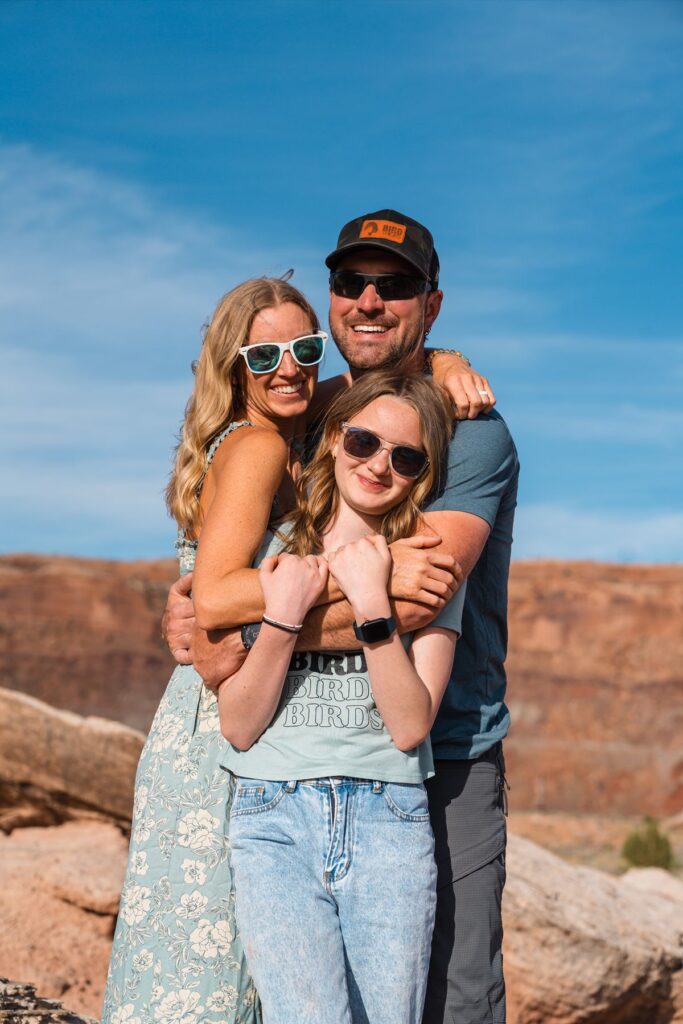
Jamieleigh, David and their daughter Capri in Moab, Utah, during a Freeflight trip. Photo by Rachael Baker.
You’ve also set world records with some of your stunts. What are the most memorable ones you’ve pulled off?
World records are nothing more than publicity stunts, right? Because of that, you can get pretty creative with it.
Our deepest underwater card stab is a good example. We were doing 12 shows a week on the island of Saipan. It’s down by Guam. We had tigers in the show; it was a huge production. In the mornings, I learned how to freedive, and I’m hitting 77 feet holding my breath for three, three-and-a-half minutes.
There’s a traditional trick called the card stab trick. Somebody selects a card on stage, throws the cards in the air, and you stab the one card they picked with a sword. So we did the same thing, just underwater. We used these plastic cards and got about a dozen scuba divers to retrieve them. I shot one of the cards with my speargun, showed it to the camera, and it was the card that was selected.
Then there was a world record where the guy had done, I believe, 182 escapes from a straitjacket in an eight-hour period, so I did 220. I had knots the size of golf balls in my back after that, though, so that was a one and done.
How often do you get nervous or scared about something going wrong?
Every time. People look at what I do and might think it’s reckless. The opposite is true. It is incredibly calculated. I’ve got a wife and daughter, and I want to live as long and happy and healthy as I can. We go through so many safety checks during stunts like those, but I’ll tell you, I’ve gotten hurt more often doing shows than skydiving or scuba diving.
Your work has taken you around the world. What are some of the most memorable places you’ve visited?
The first one that comes to mind immediately as far as, like, the most fascinating was Bishkek, Kyrgyzstan. The culture there was so rich, so warm, inviting and loving. My luggage was lost. Nobody had my phone number, but they ended up finding it and then finding me. I’ve been to places in Africa where the people are so generous and serve you so much food. And there’s Saipan, which is a U.S. commonwealth, and at that time, my wife and I were pretty newly married. It was our first time being truly away and unreachable.
But I will say, honestly, my favorite place on earth is Sandpoint. Every time I cross that Long Bridge, it doesn’t matter if it’s smoky, or if a lightning storm is going on. That’s my favorite view in the world.
In addition to his shows around the world, David DaVinci performs regularly at Silverwood and does an annual show at the Panida; his 2026 show takes place Dec. 16 (see calendar page 26).
Learn more at www.daviddavinci.com.